



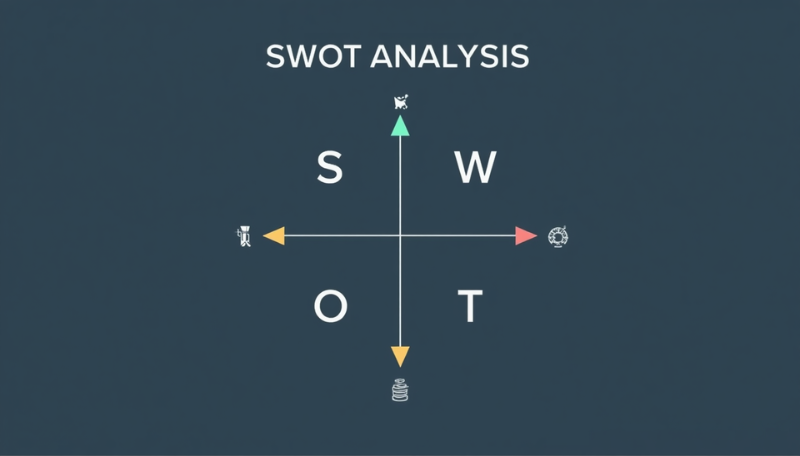
What Is a SWOT Analysis?
The four-box framework that changes how you see any decision.
Every business, project, or career move carries hidden risks and overlooked opportunities. A SWOT analysis is the simplest tool that forces you to see all four dimensions at once — before you commit to a direction.
The acronym, decoded
SWOT stands for Strengths, Weaknesses, Opportunities, and Threats. It was developed in the 1960s at Stanford Research Institute and has since become one of the most widely used frameworks in business strategy, product planning, and personal development.
The genius is in the structure: two internal factors what you control sit alongside two external ones (what the world throws at you). Together, they paint a 360° picture.
Strengths
What do you do exceptionally well? What advantages do you have?
- Unique skills or resources
- Strong brand reputation
- Loyal customer base
- Proprietary technology
Internal · Negative
Weaknesses
Where do you fall short? What could competitors exploit?
- Skill gaps or limited talent
- Weak cash flow
- Poor online presence
- Overdependence on one client
Opportunities
What trends or gaps could you exploit to grow?
- Emerging market segments
- Competitor weaknesses
- New technology adoption
- Regulatory changes in your favor
Threats
What external forces could hurt your position?
- New market entrants
- Shifting consumer behavior
- Economic downturns
- Supply chain disruptions
“The value of a SWOT isn’t the list it’s the honest conversation it forces you to have.”
THRER ARE FEW STEP YOU CAN FOLLOW TO RUN THE SWOT ANALYSIS
- Define your objective. Are you evaluating a new product launch, a career move, or your whole company? Keep the scope narrow — a focused SWOT beats a vague one every time.
- Gather the right people. Include voices from different departments or perspectives. Groupthink is the enemy of a useful SWOT.
- Brainstorm each quadrant separately. Start with strengths and weaknesses (internal), then move to opportunities and threats (external). Use data, not gut feel.
- Prioritize ruthlessly. Not every item is equal. Rank each point by impact so you focus on what actually moves the needle.
- Turn insights into actions. Pair strengths with opportunities (your best bets), and use strengths to mitigate threats. Address weaknesses before they become vulnerabilities.
When should you use it?
A SWOT analysis is useful at any moment of significant decision-making: launching a startup, entering a new market, evaluating a merger, or even planning your own career pivot. It works at the company level, team level, and individual level equally well.
The real power comes not from filling in the boxes, but from the cross-analysis: How can your strengths help you capture that opportunity? Is a particular weakness making you more vulnerable to a specific threat? These intersections are where strategy is born.
Common mistakes to avoid
Many teams fill in the quadrants and then shelve the document. A SWOT with no follow-up action is just an expensive brainstorm. Also watch out for being too charitable with strengths, too optimistic about opportunities, or too vague with weaknesses. Specificity is everything.