


Have you ever downloaded an app just to see what it was like and then realized you used it every day? Yes, that wasn’t an accident. Some products are made so well that they fit right into your life without any trouble.
To understand how certain products seamlessly become part of everyday life, it is essential to first examine the concept of SLIP and its significance in modern product design. The SLIP framework provides a structured way to analyze why some products are adopted quickly while others struggle to gain traction. It highlights the importance of minimizing user effort and maximizing accessibility from the very first interaction. In an increasingly competitive and fast-paced market, users tend to favor solutions that require little time, cost, or learning. SLIP helps identify the key factors that influence this behavior and shape user preferences. By understanding this concept, businesses and designers can create products that are not only functional but also naturally appealing and easy to integrate into daily routines.
They don’t ask for your attention; they earn it. No complicated setup, no heavy commitment, and it works right away. Before you know it, they’re a part of your daily life, like your morning tea or that one app you check before you even open your eyes.
We often think that people pick out products after carefully comparing them, but in reality, the products we use every day usually choose us because they are easy to use.
What Does SLIP Stand For?
SLIP is a conceptual framework that explains why certain products are adopted quickly and become deeply embedded in users’ everyday routines. Rather than relying on aggressive marketing or complex features, these products succeed by reducing effort and increasing accessibility.
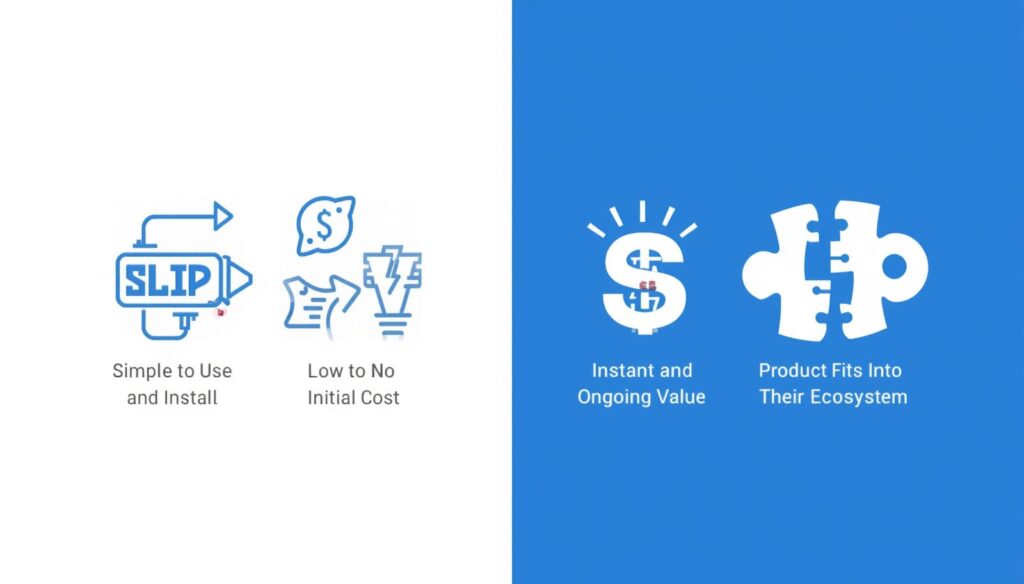
The term SLIP is an acronym that represents four essential characteristics of such products:
S – Simple to Use and Install
L – Low to No Initial Cost
I – Instant and Ongoing Value
P – Product Fits Into their Ecosystem
Each element highlights a critical aspect of user experience and product design. Together, they form a practical guideline for understanding how products move from being “just another option” to becoming a regular part of users’ lives.
This framework is especially relevant in today’s competitive environment, where users have countless choices and very little patience. Products that align with the SLIP principles are more likely to stand out—not because they demand attention, but because they make adoption feel effortless.
Simple to Use and Install
Simplicity isn’t just about having fewer features; it’s also about making things easier for the user. From the first time you use it, a well-designed product should feel natural.
The product is already doing its job well if users don’t have to stop and think, “What should I do next?” Users can easily find their way around thanks to clear layouts, familiar icons, and smooth navigation. Little things like quick loading times, easy sign-up processes and few steps can make a big difference.
Users lose interest as soon as a product starts to seem hard or take a long time to use. But they keep using it without thinking twice when it feels easy. if we wanna take an short example such Coinbase two founder came up with an idea for trading and investment in crypto they told them that they make it so easy for the user even their mother can the product and make investment so make product simple and easy to use and understandable
Low to No Initial Cost
Cost is not only about money it also represents perceived risk. When trying something new, users often wonder, “Will this be worth it?”
By reducing or eliminating the initial cost, products lower this barrier. Free trials, freemium models, or “no credit card required” options encourage users to explore without commitment.
From a psychological perspective, once users begin to rely on a product, switching away becomes less appealing. What starts as a risk-free trial often evolves into long-term usage.
for best or worst most people do not need your whole product so now a days in SaaS or they service type of products you will they give you some feature for free or will give free trial for 14 day or 1 month then if you think this is the product you want then you can buy but main thing here is onboarding people if you have confidence in your product that at that price you product give value out of it then customer will think this low cost maybe i could be in million it depends on the value
Instant and Ongoing Value
Effective products deliver value immediately rather than asking users to wait. That first interaction is critical it should solve a problem, save time, or provide a clear benefit.
However, long-term success depends on consistency. A product must continue to deliver value over time. As users experience repeated benefits, the product gradually becomes part of their daily routine. At that point, it is no longer just a tool it becomes a habit.
Instant and ongoing value is best understood through the story of Spotify. When a new user opens Spotify for the first time, they don’t have to do anything complicated to get value. They type in a song they already love, and it plays instantly. No waiting, no setup, no learning curve. That first moment delivers an immediate and obvious benefit all the music you want, right now, for free. The user doesn’t need to be convinced. They just experienced the value themselves.
But Spotify didn’t stop there. Every time you listen, the app is quietly learning. It notices what you skip, what you replay, what you listen to on Monday mornings versus Friday nights. Then every Monday it hands you a playlist called Discover Weekly full of songs you’ve never heard but somehow already feel made for you. That’s not just a feature, that’s a moment that makes users feel understood. And when a product makes you feel understood, you don’t just use it you trust it.
Over time, Spotify becomes something much more than a music player. Your playlists are there. Your taste is mapped inside it. Your running songs, your focus music, your late night moods all stored, all remembered. At that point, leaving Spotify doesn’t just mean finding another app. It means losing a version of yourself that the app has built up over years. The product has quietly moved from being a tool you chose to a habit you don’t think about.
That is the full journey of instant and ongoing value. Hook them in the first minute, reward them every time they return, and become so woven into their daily life that walking away feels like more effort than staying.
Fits Seamlessly Into their Existing Ecosystem
Users prefer products that integrate smoothly into their current routines rather than forcing them to adapt. This can include compatibility with other tools, availability across multiple devices, or alignment with existing habits. The less disruption a product causes, the easier it is to adopt.
If using a product requires significant changes in behavior, users are more likely to hesitate. But when it fits naturally into their workflow, adoption happens almost effortlessly.
People don’t resist change because they’re lazy they resist it because change costs energy, and the brain is wired to conserve energy. This means that as a product designer or marketer, your job is to make switching to your product feel like zero effort. The golden rule is simple: fit into your customer’s life, don’t ask them to fit into yours.
The best products don’t ask users to change their habits they wrap around existing habits. Take Grammarly as a perfect example. Before Grammarly, fixing your grammar meant writing somewhere, running spell check, copying the text, pasting it into another tool, and re-reading everything. Grammarly threw all of that away. Instead, they said: “We won’t make you change how you write. We’ll just sit quietly inside wherever you already write.” Whether you’re writing in Gmail, Google Docs, or Twitter, Grammarly is already there. The user changed nothing about their daily routine. The product adapted to them and that’s exactly why it grew to tens of millions of users.
The same thinking applies to every decision in your product. Don’t ask people to download an app before they see any value. Don’t force them to create an account just to get started. Don’t make them learn a new workflow or fill out long forms. Instead, let them try before they sign up, auto-fill what you already know, and add value directly inside the tools they already use every day.
If your product asks the user to do anything extra before they experience something useful, you’ve already lost most of them. The best first experience should make someone think: “This just works. Why didn’t this exist before?” That feeling is what gets customers on board not clever marketing or convincing arguments, but the simple, powerful feeling that your product made their life a little easier without asking for anything in return.
Overview of the SLIP Concept
The SLIP concept is based on a simple but powerful idea: the most successful products are the ones that require the least resistance to adopt.
In many cases, users do not actively plan to commit to a product. Instead, they try it out casually often because it is easy, accessible, or recommended. If the experience is smooth and rewarding, the product gradually becomes part of their routine without any deliberate decision-making process.
This “slipping in” happens when a product eliminates common barriers such as complexity, cost concerns, delayed benefits, or incompatibility with existing habits. By addressing these challenges, the product creates a frictionless experience that encourages continued use.
Over time, repeated positive interactions build familiarity and trust. What starts as a simple trial evolves into regular usage, and eventually, dependence. At that stage, the product is no longer perceived as new or optional it becomes essential.
The SLIP framework helps explain this transition. It shifts the focus from short-term attraction to long-term integration, emphasizing that true success lies not just in acquiring users, but in becoming a natural and lasting part of their daily lives.
Real-World Product Examples
Many successful products clearly demonstrate these principles in real life. For example, WhatsApp shows how simplicity drives adoption you can install it, verify your number, and start messaging instantly without needing instructions. Similarly, Spotify reduces hesitation by offering a free version, allowing users to explore music without any upfront cost, which often leads them to upgrade later. In terms of delivering immediate and lasting value, Google Maps stands out by providing directions, traffic updates, and time estimates right away, making it something users rely on daily. Lastly, Google Drive fits seamlessly into users’ existing workflows by integrating with tools like Docs and Gmail, allowing people to store, share, and access files effortlessly across devices. Together, these examples show how products succeed by being easy to use, low-risk to try, consistently valuable, and naturally integrated into everyday routines.
Conclusion
In today’s fast-moving and choice-heavy environment, products that succeed are not necessarily the most complex or feature-rich, but the ones that integrate effortlessly into users’ lives. By minimizing effort, reducing perceived risk, delivering immediate and consistent value, and aligning with existing habits and systems, such products create a seamless user experience that encourages natural adoption.
Rather than demanding attention, they earn it through ease and reliability. Over time, this subtle integration fosters familiarity, trust, and routine usage ultimately transforming a simple tool into an essential part of everyday life.