


currently, there are over 400 million businesses registered, and all of them are trying to sell something or create something. But if you try to name some companies, you can hardly come up with more than 20 like Apple, Google, Facebook, and others.
So what makes these companies different? How do they create products that people love? Some build strong emotional connections, some make people care deeply, and others create such a strong identity around their product that people become almost addicted to it. A great product is never just an object. It becomes a habit, a solution, a status symbol, or even part of someone’s daily survival.
In this blog, we are going to talk about that what are the ways and steps you can follow to create a product like this. How the product scale into a company and top to bottom idea to design , design to prototype , prototype to final product.
We will explore:
- How to identify valuable problems
- How to define customers correctly
- How to create strong value propositions
- The “4U” framework for validating problems
- Product defensibility and competitive moats
- Product economics and scalability
- How ideas become world-changing products
The Reality of Product Creation
Most products fail for one simple reason:
They solve problems nobody truly cares about.
People often start with technology first:
“I built this amazing feature.”
But customers don’t buy features.
They buy outcomes.
Nobody buys a drill because they love drills. They buy it because they want a hole in the wall. Nobody buys cloud storage because it sounds technical. They buy peace of mind. Nobody buys productivity apps because they enjoy organizing tasks. They buy reduced stress and better control over life.
The biggest mistake founders make is falling in love with their product instead of falling in love with the customer’s pain.
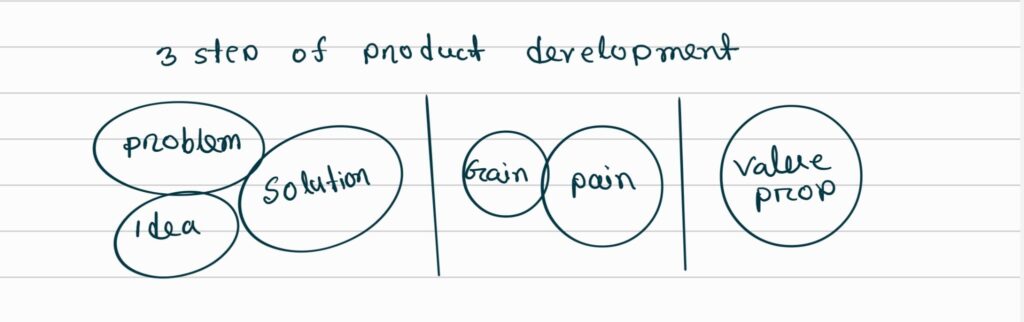
The 3 Stages of Product Development
Every successful product usually moves through three major stages:
1. Define
This is where everything starts.
Before building anything, you must understand:
- What problem exists?
- Why does it exist?
- Who suffers from it?
- Why hasn’t it been solved properly yet?
Most startups skip this stage and rush into building. That is why many products launch with excitement and die quietly.
2. Design the Idea
Once the problem is clear, the next step is designing a solution.
This includes:
- Product concept
- User experience
- Features
- Pricing
- Business model
- Technology requirements
- Competitive advantage
The goal is not to create “many features.”
The goal is to create a solution that feels: easier, faster, cheaper, smarter, or emotionally better.
3. Build the Solution
Now the idea becomes real:
- Prototype
- Testing
- Feedback
- Refinement
- Manufacturing or software development
- Market launch
This stage is where ideas become products and products become businesses. But even here, the process never truly ends. Great companies continuously improve: and technology. products, customer experience, branding, pricing.
Understanding Pain and Gain
Every purchase humans make comes from one of two things:
Pain
People want to: reduce frustration, save time, remove fear, avoid loss, reduce effort.
Examples:
- Food delivery solves inconvenience.
- Antivirus software sells fear protection.
- Insurance reduces uncertainty.
- Cybersecurity prevents catastrophic loss.
Gain
People also buy things to: feel status, increase comfort, improve identity, gain recognition, experience pleasure.
Examples:
- Luxury watches
- Sports cars
- Premium fashion
- Flagship smartphones
A strong product often combines both pain removal and emotional gain.
Creating a Strong Value Proposition
A value proposition explains:
Why should someone choose your product instead of every alternative?
A simple framework:
- Who is the customer?
- What problem are they facing?
- Why are current solutions disappointing?
- What does your product offer?
- What key benefit makes it different?
Example
Imagine you are building a smart budgeting app for university students.
Customer
Students struggling with monthly expenses.
Problem
Existing finance apps are too complicated.
Solution
A simple AI-powered budgeting tool designed specifically for students.
Key Benefit
Easy expense tracking with automatic savings suggestions.
That clarity becomes your foundation.
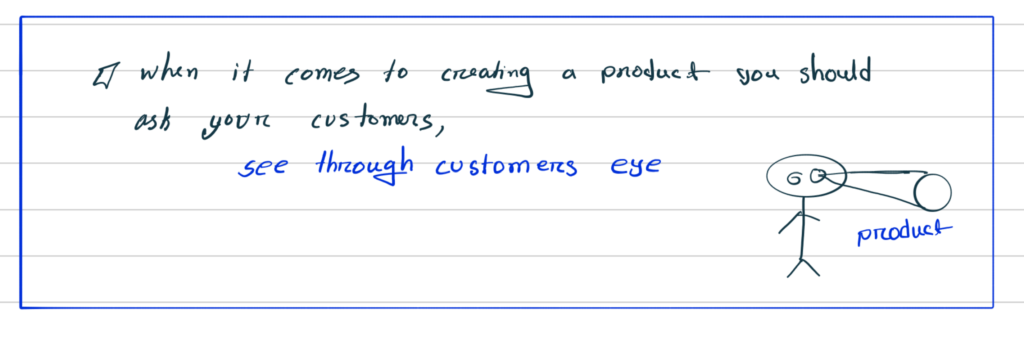
Define your custoemr base
- find who is your customers
- where they live where you can find
- do not target everyone
- A segment or minimal viable segmetn { that you specifically design , tarhet and talk baout tha typr pf people }
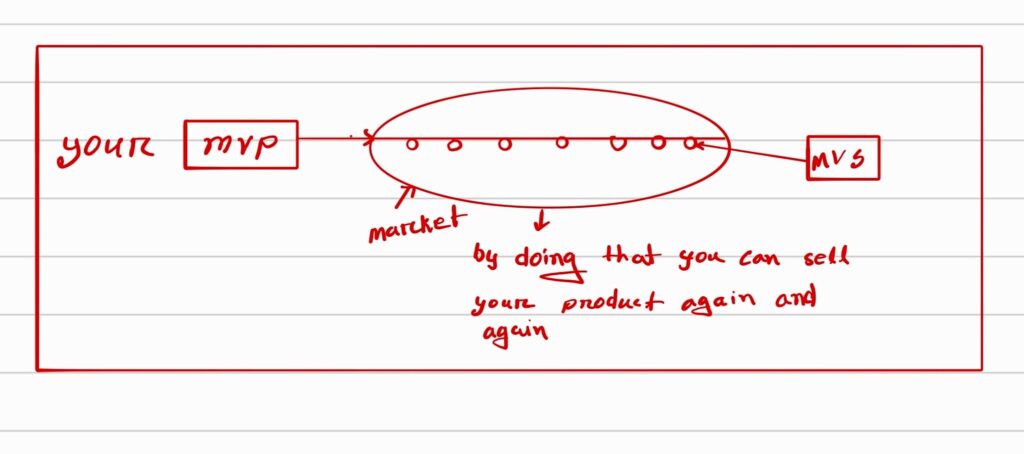
by doing that you find your customer contact with ask them what are the are the problem their have tith curretn solution what will they need to overcoemt the obsticals
Define the problem
To define the the problem we follow the concept of 4U
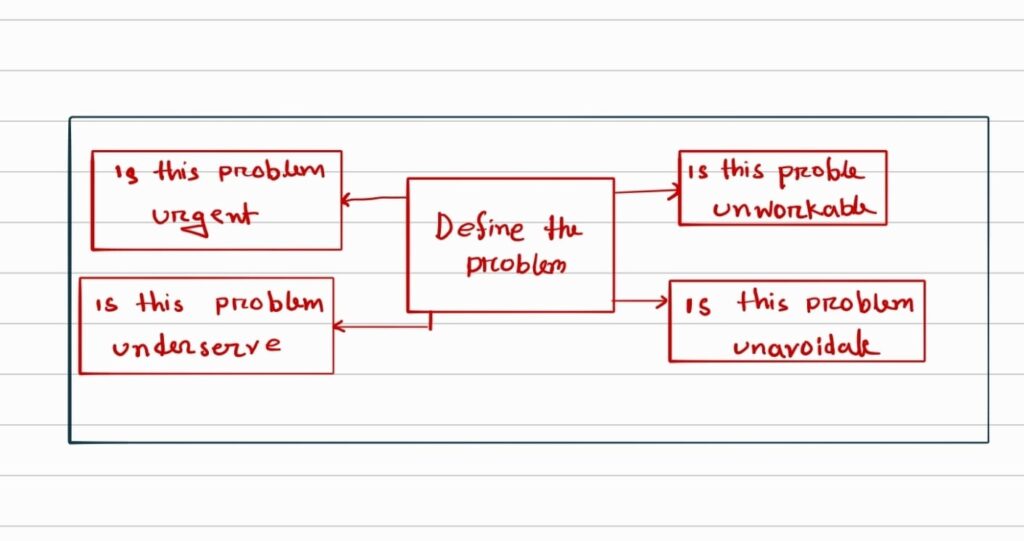
unworkable
Is this problem so hard that people think it is impossible? Take SpaceX as an example. Their vision is to send millions of people to Mars. Most people are even afraid to talk about it because it sounds unrealistic. But they have created an entire private space industry around this vision.
The same goes for achieving AGI. For years, people have been talking about it, and it still feels far away. Yet now, companies and investors are pouring trillions into trying to achieve it.
But we are not only talking about billion-dollar industries or the top 0.1% of companies. We are talking about where we can actually start. The reality is, if people can get a solution easily, your customers won’t wait for you. They will always look for something faster, better, and cheaper.
The lesson: Big opportunities often hide behind difficult problems.
Unavoidable
tThe best problems to solve are the ones where people are truly suffering — where the pain is deep and they simply cannot ignore it. In these situations, your product or service is not a luxury, it becomes a necessity.
Think about something like a cure for cancer. If someone finds a real solution, people will rush to it. You won’t need to convince customers or spend heavily on marketing. Demand will come automatically because the problem is both unavoidable and extremely painful.they problem you try to solve people are suffring or deep pain they just can not avoid your prodcjt sor seriovce it, if any found cure forn the cancer that you can on board thousands people to but your satff becuase unworble and is unavoidalbe
problem that are unavoidable such as
- education
- getting sick
- findign sure
- global financial crisis
- cyber security crisis
- natural disaster
- wars
The stronger the pain, the less marketing is required.
URGENT
making a product that urgent which is must need anyway at any cost tapping that market you di not need some kind of other worldly strategy for marketing or finance or some kind other things during the Covid19 you had shortage of musk where people needed that so badly they wanted in anyway like you people ware dying for that I was that urgent you had that people wanted that anyway so what you are doing it can be figured out that is this problem urgent for this what people are missing from their live are people losing their lives for this problem is your product peace deal between if it is not urgent people are not taking it you can make it urgent through teaching them also such as the whole entire anti virus industry was built on a false idea if they do not get they loss their valuable data so people bought it but their was not such thing as virus.
A product tied to urgent need can grow extremely quickly. But urgency can also be created through education.
Example: The cybersecurity industry grew partly by teaching people the risks of losing valuable data. Fear, when real and meaningful, creates urgency.
UNDERSERVE
The best opportunities aren’t where no one has gone they’re where no one has gone far enough.
Most people search for markets with zero competition. But the real opportunities hide in plain sight: industries full of players, yet full of frustrated customers.
Banking is a perfect example. It had existed for centuries before the internet. And yet, in the late 1990s, there was no simple way to send money online. Banks hadn’t solved it. Nobody had. That gap became PayPal.
“The best opportunities don’t come from markets with no players. They come from markets with players who stopped listening.”
An underserved market isn’t empty it’s broken. Look for: prices too high for most people, products too complex for non-experts, or solutions that work for one group but ignore everyone else. When customers are settling, there’s a business waiting to be built.
Don’t ask “where is there no competition?” Ask “where are people being let down?” That’s where the next PayPal is hiding. The market wasn’t empty. It was broken.
Is you product has DEBT ?
By this, i mean how much your product depends on external factors such as other companies, industries, or systems.
You should carefully evaluate:
- Dependencies : Is your product reliant on other companies, platforms, or suppliers?
- External factors : Consider market competition, regulations, economic conditions, technology trends, and changes in user behavior.
You also need to think about potential backlash after launching the product:
- How will customers and users react?
- Will investors or executives support it?
- Could it face criticism on social media?
Finally, timing is critical:
Is the technology mature enough to support it?
Is this the right time to introduce the product?
Does the market actually need or want it? know more
Does Your Product Have “3D”?
Every strong product should be evaluated through three dimensions:
- Defensible
- Disruptive
- Discontinuous
1. IS YOUR PRODCUT DISRUPTIVE?
disruptive product is not just new or slightly better it completely changes the game. It changes how people behave, how they buy, and how they live.
We’ve seen this happen many times:
- PayPal changed how people send and receive money.
- Facebook changed how people communicate and connect.
- Amazon changed how people shop.
- Apple made phones and computers so simple that anyone can use them.
Today, almost everyone carries a powerful device in their pocket that can run AI and perform advanced tasks.
The lesson is simple:
Don’t just try to make a better product try to change how the game is played.
2. Is your Product Discontinuous?
A discontinuous product is not 10% better. It feels 10x better. People expectation the first iPhone was not just better at one thing. If look back Stev presentation he was talking about many things: like putting song, in cameras, calls, docs at same time & place. He compared with aligning technology and the people. Customers were amazed by the out come. Now we are living whole new world because one change create trillion dollar industry & millions jobs. Life become easier. Thinking or developing about the product we have, look at competitors. If the product exist or if not ask the MVS that what is the thing make their life more and life it was never before.
IS IT DEFENSIBLE ?
If your product becomes successful, competitors will come immediately. So the question becomes:
What protects you?
This is called a MOAT.
- proprietary IP
- government license
- favorable location
- favorable long tern contract
- minimum efficient scale facility ( market can not support more )
- access to (property ) data ( e.g google , Facebook Bloomberg )
defensibility with scale
- network effect
- switching cost
- cost advantage due to scale -economics of scale
- brand loyalty
you need to have something to defend your product or service or the idea so that live in the market otherwise people crush you like little boy in the big boy game.
Product Economic Analysis
A product is not successful just because people like it. It must also make economic sense.
Questions Every Founder Must Ask
Cost Structure
- What is the total production cost?
- What is the cost per unit?
- What are fixed vs variable costs?
Pricing
- Is the product premium or affordable?
- Is it competitive?
- What will customers realistically pay?
Profitability
- What is the profit margin?
- How much volume is needed?
- How long until profitability?
Break-Even Analysis
A business survives when revenue exceeds total cost.
Understanding break-even tells you:
- how many customers are required,
- how much capital is needed,
- and whether scaling is realistic.
Without economic sustainability, even loved products can fail.
A Complete Example: Building a Real Product
Imagine you are building a smart skincare brand based on climate-adaptive products for humid countries.
Step 1: Identify the Problem
Many skincare products are designed for Western climates.
But customers in tropical countries face:
- excessive humidity,
- sweating,
- oily skin,
- pollution,
- and heat-related irritation.
Existing products feel too heavy.
Step 2: Define the Customer
Instead of targeting:
“everyone interested in skincare”
You target:
- urban young professionals aged 20–35 living in hot, humid cities.
Now your messaging becomes sharper.
Step 3: Create a Better Solution
Your product becomes:
- lightweight,
- non-sticky,
- humidity-resistant,
- fast-absorbing,
- affordable,
- and dermatologist-tested.
Step 4: Create Defensibility
You build:
- unique formulations,
- strong branding,
- creator partnerships,
- customer community,
- climate-specific research data.
Step 5: Scale
Eventually:
- one product becomes multiple products,
- the brand expands regionally,
- customer trust increases,
- distribution improves,
- and the company evolves into a full ecosystem.
This is how products become companies.
Final Thoughts
The world does not reward products simply because they exist.
It rewards products that:
- solve meaningful pain,
- improve human behavior,
- create emotional value,
- and become difficult to replace.
The goal is not just to launch something.
The goal is to build something people genuinely want in their lives.
Because the strongest companies are not built on technology alone.
They are built on understanding humans better than everyone else.