



The Innovator’s
Dilemma
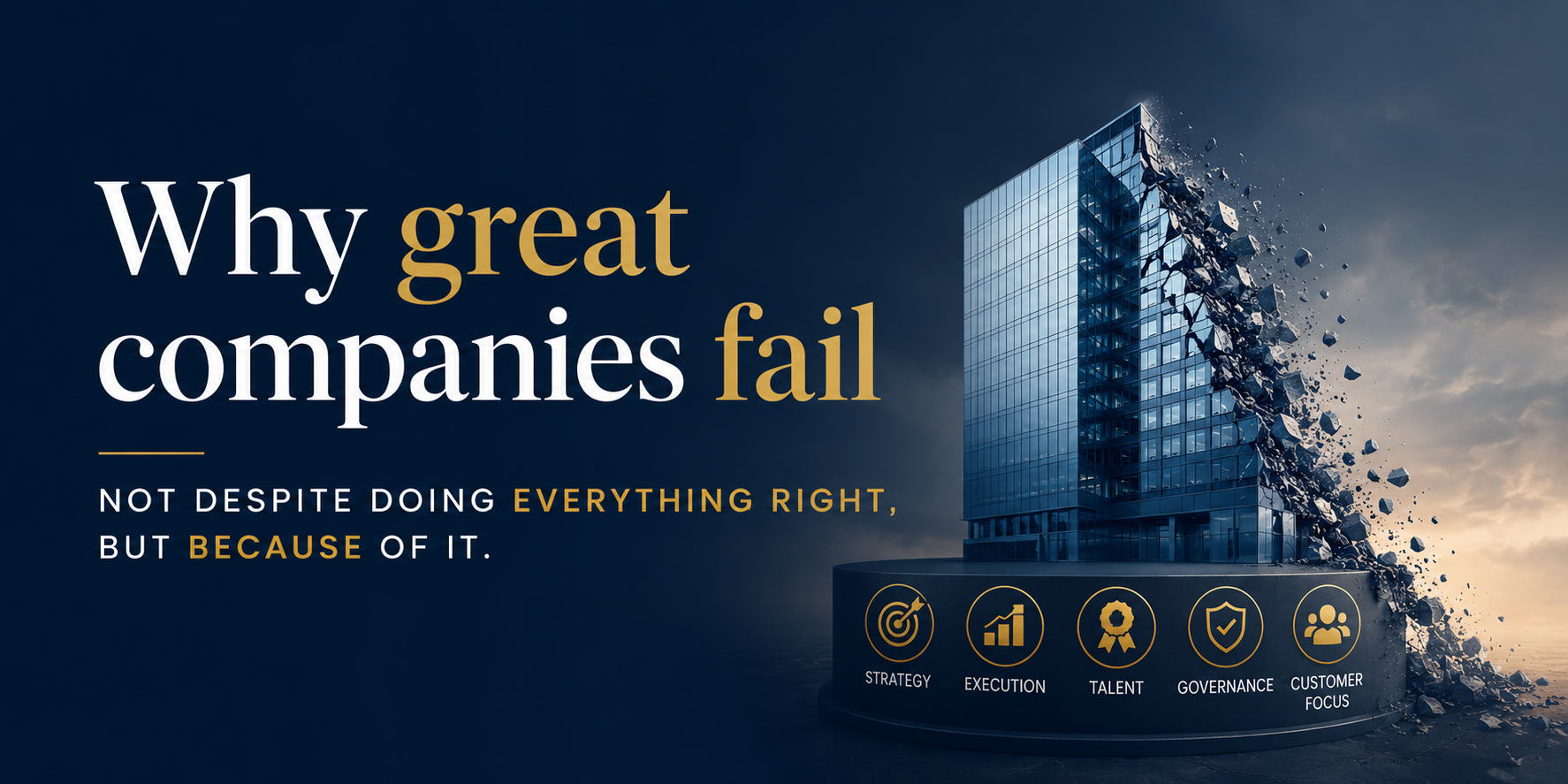
Why great companies fail — not despite doing everything right, but because of it.
There’s a deeply unsettling idea at the heart of Clayton Christensen’s masterwork: the better you are at listening to your customers, the more vulnerable you become to being destroyed by a startup nobody takes seriously.
Published in 1997, The Innovator’s Dilemma remains one of the most cited — and most misunderstood — business books ever written. It is not a story about complacency. It’s a story about rational decisions made by smart people that collectively produce catastrophic outcomes. That’s what makes it so chilling, and so useful.
The central paradox
Christensen opens with a puzzle. Why did companies like Digital Equipment Corporation, Sears, Bucyrus Erie, and US Steel — companies that had been exemplary performers — collapse when new technologies arrived? They had good managers. They invested in R&D. They listened carefully to customers. And yet, they missed the wave.
“The logical, competent decisions of management that are critical to the success of their companies are also the reasons why they lose their positions of leadership.”
The answer, Christensen argues, is that there are two very different kinds of innovation — and companies are structurally rewarded for pursuing only one of them.
Sustaining vs. disruptive innovation
Sustaining innovations make good products better. Faster hard drives. More fuel-efficient cars. Sharper cameras. These are the innovations that incumbent companies excel at, because their best customers demand them and their margins reward them.
Disruptive innovations do the opposite, at first. They enter the market as worse products by every conventional measure — cheaper, simpler, lower-performing, aimed at customers nobody in the industry is paying attention to. But they improve over time, creeping upmarket, until one day they’re good enough for mainstream customers. And by then, the incumbents have no idea how to compete.
Real-world examples
Laughably underpowered vs. minicomputers — until they weren’t. Destroyed DEC and Wang over a decade.
Served corporate clients profitably. Couldn’t see the PC as a serious threat. It was — fatally so.
Niche, inconvenient compared to Blockbuster’s immediacy — but cheaper, and improving relentlessly.
Focused on its profitable core. Late fees funded the store network that ultimately anchored it in place.
Why rational decisions lead to irrational outcomes
This is the true genius of Christensen’s framework. He doesn’t blame executives for being blind or lazy. He shows that the very processes that make large companies successful — listening to customers, measuring returns, allocating capital efficiently — actively steer them away from disruptive opportunities.
- 1 The disruptive technology is dismissed. It’s worse on every metric that matters to current customers. Margins are thin. Market size appears small. The business case doesn’t pass internal hurdles.
- 2 The disruptor finds a foothold. Non-consumers or low-end customers — those the incumbent actively ignores — adopt the new technology. Nobody inside notices, because it’s not on any dashboard that matters.
- 3 The technology improves upmarket. Now it’s good enough for mainstream customers, and the incumbent is caught flat-footed — having spent a decade perfecting a product that solves yesterday’s problem.
What leaders can actually do
The prescriptive section of the book is less flashy than the diagnosis, but no less important. Christensen’s core recommendation: if you want to pursue a disruptive innovation, you must spin it out. Give it to a separate team, with a separate P&L, serving a separate market, free from the resource allocation processes of the parent company.
This isn’t just organizational tidiness. It’s survival. A disruptive unit embedded inside a large company will always lose the internal competition for talent and capital — because sustaining innovations show better short-term returns, and that’s what the incentive system rewards.
Intel’s creation of the Celeron processor — a deliberately lower-end chip to protect the low end of the market from AMD — is one example Christensen points to. It required Intel to cannibalize its own margins. It was painful. And it worked.
Why it still matters, nearly three decades later
Read any postmortem on a company that failed to navigate a technology shift — Kodak, Nokia, Toys”R”Us, print newspapers — and the Innovator’s Dilemma framework quietly explains almost everything. The remarkable thing is that most of these companies saw the disruption coming. They just couldn’t act on it.
For anyone building a product, launching a startup, or leading a team, the book poses one essential question: who are the customers you’re currently ignoring? Because somewhere in that uncelebrated, low-margin corner of the market, a competitor might be learning to walk before they learn to run straight at you.
Essential, rigorous, and quietly terrifying. The Innovator’s Dilemma is one of those rare books where the framework is so clean and so explanatory that once you see it, you can’t unsee it. Required reading for anyone in business, technology, or strategy — and particularly relevant for anyone planning a product launch into an established market.